
I’ve recently started traveling to various horse shows and watching trainers give lessons and school their students both in the ring and in the barns. When you decide to teach, you all of a sudden become much more aware of the teaching styles of others, and, how their students receive their instructions. Continue reading “Learning To Ride Just Isn’t Sexy Enough”

There’s a toy, so it it must be a Happy Meal! #kittyconvo
Share this:

FEI Tribunal Disqualifies Maxime Livio (FRA) And French Eventing team
What are your thoughts on the whole team being disqualified?

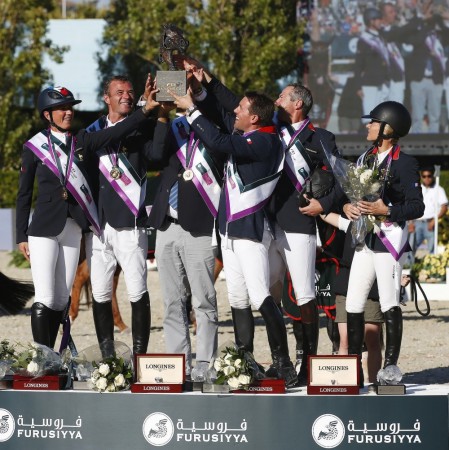
The FEI Tribunal has disqualified Maxime Livio (FRA) and Qalao des Mers from the Eventing competition of the FEI World Equestrian Games™ 2014, following a positive for a Controlled Medication substance. Livio, fifth in the individual rankings, was also a member of the French team, which finished fourth in Normandy to secure qualification for the Rio 2016 Olympic Games. The FEI Tribunal has also disqualified the French team, resulting in the loss of its Olympic qualifying slot.
Samples taken on 29 August 2014 from the horse Qalao des Mers (FEI ID 103MQ19) returned positive for Hydroxyethylpromazine sulfoxide, a metabolite of the sedative Acepromazine. Acepromazine is a Controlled Medication substance on the FEI Prohibited Substances List. Controlled Medications are substances that are regularly used to treat horses but which are not allowed in competition in order to maintain a level playing field.
Any breach of the FEI’s Equine Anti-Doping and Controlled…
View original post 238 more words
Share this:


Trail Riding
My mare has done a lot in her lifetime; mini prix showjumping, dressage, foaling, and now back in the showjumping ring.
While it’s important to keep show horses in a regular workout routine, it’s also important to get them relaxed and out of the ring. Your horse should love their job and you don’t want their sourness to the ring getting in the way of that.
Especially after a hard ride, I love to take Honey out of the ring to stretch her muscles, relax, and get used to being ridden outside the confines of an arena. Plus, it’s a great way to continue to build your relationship with your horse…after all, a horse and rider’s success is based on mutual trust as a team.
Still worried? Think of it this way: if your horse doesn’t get used to being ridden outside of the ring, you can’t blame him/her if they act up while riding them on a show ground.
Always trail ride with a buddy, or at least a cell phone, and always be sure to stay alert and aware of your surroundings. Safety first!
Cheers!
Share this:

It’s A Nice Life
Share this:

Jump Into Spring

If you’re anything like me then you love to jump. . .and so does your horse. The problem is, when you don’t have a covered arena, the winter season can get you out of shape and out of practice. Not only does your horse need to regain lost strength and stamina but so do you! Not to mention, as the rider you are the “driver”. This is my slow and steady workout to get my mare, Honey, back in show jumping shape.
Week 1: Do It Without the Jumps
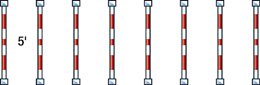
At the start of any conditioning series you really want to get a good feel for where you and your horse are as a team. The first few rides of week one I use to feel my mare out with flatwork. It’s important to have your horse listening to your aid, moving off your leg, balanced, and adjustable on the flat before you think about adding obstacles into the mix. If you have all of these flatwork elements, “checked off”, then you’re good to go with week one! My rides always start with about 10-15 minutes of flatwork focusing on transition as well as lengthening and shortening. Transitions, especially when done correctly ensuring your horse is using their hind ends and not falling forward, are excellent practices to building muscle and increasing responsiveness. After 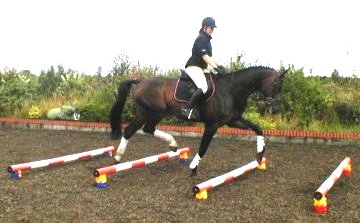 you’ve warmed up with some flatwork, add some trot poles into your workout. These are great for getting your horse to really use their muscles to pick up their feet. If you’re more advanced, raise the trot poles for an added challenge for your horse. Just be careful, I have a hot horse and we have to walk through raised trot poles before attempting to trot them because she thinks that she’s supposed to jump them. Always be listening to your horse and supporting them.
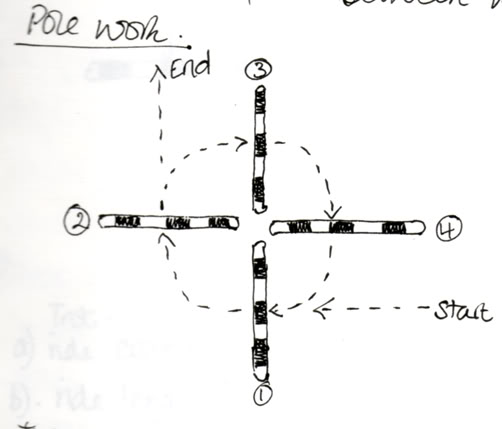
Now, the trot poles are for the horse but the canter poles are for you. Canter poles are great because they’ll help you regain your eye for distances once you start jumping but they’re easy on your horse’s legs. The exercise below will help with your eye but more so help with your seat, your position, and how much you’re supporting and helping to balance your horse. If you’re just working on you eye, I suggest single canter poles or canter pole lines, etc.
Week 2: Hot to Trot
Keep the fences low, either small x-rails or low verticals and keep it simple with single fences. You should still start your workout with good flatwork exercises focusing on elements of balance and adjustment that you feel is needed for you and your horse to improve. I know, I know, we all hate trot jumps but they’re actually super helpful for two reasons: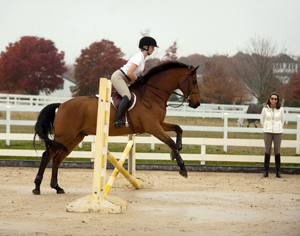
- They’re great for building muscle in your horse’s hind end because they force your horse to rock back and use their haunches to jump. Remember not to let them rush the trot jumps so this can happen!
- They force us, the rider, to really keep our upper body back and let the horse jump up to us instead of us jumping ahead of the horse.
Week 3: Exercises
This is the time to think about all the courses you’ve jumped in the past and dissect them element by element. Keep the fences at a low height (but slightly higher than your trot jumps) and practice the course elements you set up. For me, I make sure to set up long straight lines, rollbacks, long approaches to single fences, skinnies on the short end of the arena, bending or broken lines, and even some fences set up on a serpentine. While you can’t do all of these at once you can do at least half of them and only have to set up four (4) jumps in the ring so don’t get overwhelmed. Remember, the idea here is to keep the fences low and work on the technique and execution of riding each element individually. We’re NOT putting them into a full course just yet but rather practicing so that when we do, both rider and horse are confident and ready to ride.
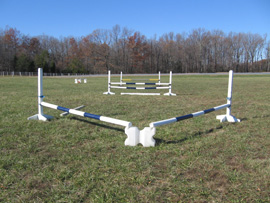
*Note: I never jump every day of the week. Even when practicing exercises over low fences, I’ll only do three (3) days a week of jump work with one (1) day off and three (3) days of complementary flat work.
Week 4: Set the Course
Now it’s time to put all the exercises we worked on in week three into a full course. My suggestion for you is to have the jumps set so you can ride a more simple, hunter-like, course for your first course and if all goes well, add some equitation-like elements to make it more challenging. It depends on your horse, so be sure to be listening to them, but I usually raise the jumps to a low schooling height for our full course with some trot jumps as my warm-up. For example, my mare and I show at 3’6″-3’9″ so our height for this week in our training will be 3′-3″ if she feels good over the 3′-fences. I always jump a few single fences at this height before asking her to do a full course to get a feel for how she’s jumping. Also make note of your horse’s breathing and give them plenty of breaks to stretch out and walk if they’re sounding like a freight train. Pushing them is good to an extent but I always ere on the side of caution if my mare is telling me she’s had enough.
After week four I play it by ear but if you’re curious, this is what my horse’s weekly workout schedule looks like:
Monday: Rest
Tuesday: No Stirrups Flatwork
Wednesday: Trot Jumps
Thursday: Flatwork
Friday: Low/Medium Exercises
Saturday: Full Course/Trail Ride
Sunday: Light Flatwork/Trail Ride
Share this:


Leave the Seesaw on the Playground

I recently was lucky enough to make my way down to the Winter Equestrian Festival in Wellington, FL and watch the jumper derby that was being held two weeks ago.
Now, I’m not calling myself an expert but there are a few things that just make sense:
- A horse cannot be looking at the ground if it is expected to jump a 5′ fence
- In Man vs. Horse tug-of-war, the horse wins…every time
While many riders had wonderful rounds it amazed me that at this level of competition, these mistakes were being made. There have only been two times in my life where I have wished that the horse would throw its rider and get the heck out of there.
First, was when a “trainer” (no clue who) couldn’t handle a horse she was showing and decided to jump a 3′ course in draw-reins. Second, was at this jumper derby when the rider literally pulled the horse’s teeth out and then spurred it over the fences. The first time, the trainer did get thrown and the horse did get the heck out of the ring before politely waiting by the schooling area for someone to catch him. This jumper was forgiving (I guess) and instead of throwing his rider, he simply refused to jump.
I find it so helpful to watch people ride at upper-levels because every mistake made is amplified and by watching others, you can better analyze and improve your own riding. How does that quote go?
If you do not learn from history, you’re bound to repeat it.
Well, learn from the riding mistakes of others so you don’t find yourself approaching a 4’9″ fence and feel your horse slide to a halt because your constant seesawing on his/her face is not helping anyone. I know I’ve kept that thought in the back of my mind for every course I’ve ridden & the times a compromise with my mare are the times we go double clear.
Share this:

Equine Ballerina
I started riding Western & barrel racing out in Colorado when I was still in the single-digits [in terms of my age]. Since my family lived in Connecticut, I soon started riding English and by middle school I was showing in the hunter/equitation ring. About halfway through high school, I got burnt out between the politics and the money involved in equitation so I flat out quit riding. I had to sell my horse in order to pay for college anyways so I figured, what the heck…no horse, no money for the show, and, if I quit, no more politics or stress.
So what did I do with my time?
I went back to dance class and picked up ballet..yes..ballet. I promise, there was no tutu involved but nevertheless…I was a ballerina for my senior year of high school. At about that same time, there was a 27-year-old riding trainer at my school/barn (they were one in the same), who saw the real me better than I could at the time. She convinced me to start riding again; training with her and her students for IEA (Interscholastic Equestrian Association) horse shows. Stay tuned for another post on IEA but, for the sake of this story, I’ll summarize by saying that IEA shows are horse shows for students in middle and high school to compete in one of four divisions. At these shows, you leave your own horses at home and instead, you ride one of the hosting farm’s horses that is selected by pulling a [horse’s] name out of a hat.
Anyways, I started riding and showing again solely to fill the “Open” division for our IEA Team. Though I had always placed well at shows, this became the first time that I was consistently placing in the top three at every show. Fast forward to the Spring of my senior year of high school and I ended up winning the 2010 IEA National Finals for my division.
So what does this have to do with ballet?
Answer: Everything!

In equitation, position is over 50% of the deal. Next to modeling, equitation may be one of the most judgmental competition forms that exists. However, ballet can improve your position (and your scores) more than you could ever imagine (at least it was a surprise for me). While I strongly suggest taking a Barre class or two (it’s seriously a great workout & will improve your position just like ballet class), I will give you the key tips that will really help (though a formal instructor is probably better).
Tip 1: Engage your core!
How?
Stand with your back against the wall. Engage your core and tilt your pelvis forward so there is no room between your back and the wall (thus removing the arch in your back). Now, remember how this feels and try to do it without the wall as your guide.
Tip 2: Keep your shoulders back AND down.
How?
You can practice this against the wall as well for a guide but be sure check yourself every now and then by rolling your shoulders up, back, and then down. Don’t forget to keep engaging your core!

Final Step?
Do this on your horse.
It will take time to build the muscle memory but I PROMISE you, it will be worth it and help your position and connection with your horse on both the flat and over fences.
Questions? Please post them!!!!
Can’t wait to hear from you!
Share this:

Flatwork Matters [Even When You Jump]
Every time I tell people I’m a jumper, especially when I talk to people who mainly focus on the dressage, I can see their expression change to a smirk & it’s almost as if they’re thinking, “yeah she can jump but she probably let her flat work go in order to get there”.
Unfortunately, at one point in time that assumption would have been correct. It took my years to realize just how important your flatwork can be when you’re jumping. If I could sit with you and watch all the grand prix riders go through their courses I would love it! Since I can’t, let’s imagine for a moment that we’re at WEF in Wellington, FL & we’re watching all the top show jumpers from around the world.
Watch their approach to the fences; their positions; their seat & their aids.
It’s even better during the jump-off rounds. You can see the adjustments more clearly since they’re trying to both go clear and jump the fastest time.
Your flat work matters because your flatwork could be the reason you knock the rail, your horse stops, you get a bad distance, or you miss the jump completely. You and your horse are a team when you ride, whether you’re jumping or flatting your horse should be listening to your aids and you should be listening to your horse. If you do your flatwork properly, then you’ll be able to respond to any changes that may occur in your course.
I remember I was riding a 5-year old on his first trip down to Palm Beach, FL for WEF & he spooked at everything! It made it that much more important that I used my seat & did my flat work in the corners not only to set him up for the next fence but to also bring his attention back to me so that he was listening to me and not the spectators, announcers, food stand owners, or other exhibitors.
The horse I have now requires flat work in order to bring her back after every fence. She’s a hot horse & a jumper meaning I don’t have the luxury of wide turns to re-group and focus on flat work so I have to be direct & clear with her in a short period of time without becoming too reliant on one aid or another. Here’s where “flatwork” as a whole comes in. I can’t just pull a horse’s teeth out or spur her to make her listen to me…I have to work with her, as a teammate, and communicate using all my aids. With proper flatwork training at home, it’s a lot easier for me to make corrections quickly AND properly in order to ensure a clean and quick show jumping round.
Need some flatwork exercises?
- True-bend & Counter-bend: try changing the bend every 8-10 trot steps and make sure that you’re not only changing the bend of their neck but rather you’re changing their entire bend using all your aids (leg, seat, & then hands last).
- Transitions: I know it may sound simple but the more transitions you do, the better. Not only will it build muscle for your horse but it will also improve responsiveness between horse and rider. Try doing transitions between gaits as well as transitions within gaits. To really challenge yourself, you can set two ground-poles 7 (this number is up to you) canter strides apart. Go through the poles in 7 strides, then lengthen the stride the next time through to get 6 strides, then lengthen more to get 5 strides, then go back to 7 strides, then shorten the next time through the poles to get 8 strides, then shorten even more the next time to try and get 9 strides. Remember, the key here is not to ride like a bat out of hell for fewer strides or ride like you’re going to pull your horse’s teeth out to fit the additional strides, rather ride from your seat and leg for both with your hands as an additional aid. Your body can do wonders in terms of communicating with your horse so try and open that line of communication.
- Spiral Circles: You can do these at the walk, trot, and canter if you want depending on your level of experience. Start on a 20-meter circle and as you keep going around the circle you continue to make it incrementally smaller. Make sure the inward movement is coming from your leg asking your horse to move its whole body in, like you would if you were asking for a leg-yield. You’ll feel what movement is right for your horse. As the circle becomes smaller and smaller it will be harder and harder for your horse to continue the forward movement and will require immense support from your seat and leg as well as immense work from your horse’s hind end (you’re essentially asking for haunches-in). When you’re ready, use your inside aids to push your horse outwards to incrementally widen the circle (now essentially asking for haunches-out). Then switch directions and do it again after giving your horse the chance to trot on a loose rein and stretch their neck and back out.
- Counter Canter: This won’t be easy for many horses but it’s an excellent exercise for both horse and rider. Start with trying to counter-canter (hold the canter intentionally on the wrong lead) all the way around the ring. If you’re already there, here’s an exercise that will be helpful if you’re showing in upper-level equitation or if you’re just looking for a challenge. Pick up your counter-canter up the long-side of the arena. Hold it around the short end through both the corners. Continue you’re counter-counter half-way down the opposite long-side then push your horse onto the quarter-line before turning them in towards the rail to change direction (while holding the same lead) to end up on the proper lead & halt in the corner.


 Equestrian Digest